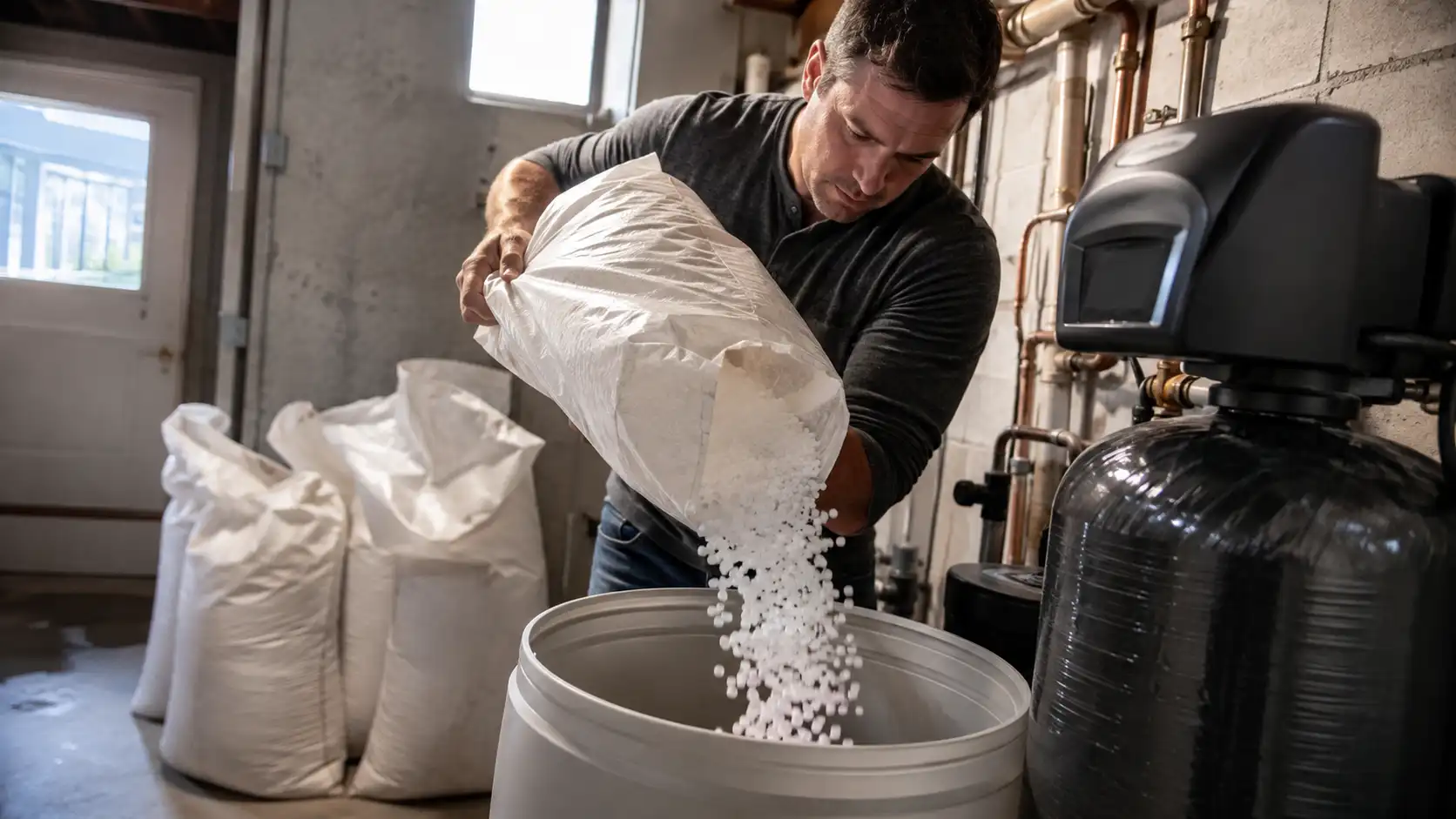
A water softener is supposed to quietly do its job in the background – removing hardness minerals, helping prevent scale buildup, and making everyday water use a little easier. So when you suddenly notice that the salt level in the brine tank is dropping faster than expected, it can feel like your softener has developed an expensive new hobby.
The good news is that excessive salt consumption does not always mean the entire system is failing. Sometimes the cause is a simple setting, a change in household water use, or a maintenance issue. In other situations, higher salt consumption can indicate that the softener is regenerating far more often than it should.
Understanding why this happens can help you spot problems early and keep your system operating efficiently.
How Much Salt Should a Water Softener Normally Use?
There is no single amount of salt that every water softener should consume. Salt usage depends on several factors, including water hardness, household size, water consumption, softener capacity, and how the system is programmed.
A household with very hard water and several people naturally requires more regeneration than a smaller household with moderately hard water.
However, you should generally notice a reasonably consistent pattern. If you previously added salt every couple of months and now find yourself carrying another heavy bag to the basement every few weeks, something has probably changed.
Your water softener should regenerate only when necessary. Modern demand-initiated systems can measure water usage and regenerate based on actual demand rather than following an unnecessarily frequent fixed schedule.
Your Water Hardness Setting May Be Too High
One of the first things worth checking is the hardness setting programmed into the control valve.
A water softener needs to know approximately how much hardness it is removing. This information helps the system calculate when the resin bed needs regeneration.
If the hardness level is programmed significantly higher than the actual hardness of your water, the softener may assume it is doing more work than it really is. As a result, it may regenerate too frequently and consume additional salt.
This can happen after installation, after somebody changes the settings, or when the system was never calibrated correctly in the first place.
Water hardness should ideally be tested rather than guessed. Accurate testing allows the equipment to be programmed according to the actual mineral content entering your home.
Your Water Softener May Be Regenerating Too Often
Regeneration is the process that restores the resin beads inside the softener so they can continue removing calcium and magnesium from the water.
During this process, salty brine passes through the resin tank. Naturally, every regeneration cycle consumes salt.
If regeneration happens too frequently, salt consumption quickly increases.
Common reasons for excessive regeneration include:
- Incorrect hardness or capacity settings
- A malfunctioning flow meter
- Increased household water consumption
- A system that is undersized for the home
- Incorrect regeneration programming
- Internal control valve problems
For example, a softener sized for two people may struggle when the household suddenly grows to five. More water passes through the system, meaning the resin reaches its treatment capacity faster.
However, frequent regeneration without a corresponding increase in water use deserves attention.
Your Household May Simply Be Using More Water
Sometimes the water softener is innocent.
Before blaming the machine, consider whether your household water consumption has recently increased.
Maybe relatives are visiting. Perhaps someone discovered the joy of 25-minute showers. Maybe you’ve started doing more laundry, installed a larger bathtub, or changed your daily routine.
Since many modern water softeners regenerate according to the amount of water used, higher household consumption naturally leads to increased salt consumption.
Even small plumbing leaks can have an impact. A continuously running toilet, dripping fixture, or unnoticed leak can increase water usage enough to trigger additional regeneration cycles.
Checking your water bill can provide useful clues. If both water consumption and salt consumption increased around the same time, the softener may simply be responding to greater demand.
The Softener Could Be Too Small for Your Home
Proper sizing is extremely important when choosing a water softener.
A system that is too small may technically soften your water, but it will have to regenerate much more frequently to keep up with household demand.
Think of it like using a small coffee cup to empty a bathtub. It can technically be done, but you are going to be making a lot of trips.
Water softener sizing should consider more than just the number of people living in the home. Professionals typically evaluate water hardness, daily water consumption, peak flow requirements, iron content when applicable, and the usable capacity of the system.
An appropriately sized system can provide sufficient soft water while reducing unnecessary regeneration and salt waste.
There May Be a Problem With the Brine System
The brine tank plays a central role in regeneration. Water enters the tank, dissolves salt, and creates the brine solution used to recharge the resin.
Several components help control this process. If one of them stops working correctly, the system may use more salt or water than necessary.
Potential problems can include:
- A malfunctioning brine valve
- Incorrect float adjustment
- Excessive water entering the brine tank
- A restricted or damaged brine line
- Problems with the injector or venturi
- Control valve malfunctions
These issues are not always obvious just by looking inside the salt tank.
In fact, repeatedly adjusting settings without identifying the actual cause can sometimes make the problem worse. Professional diagnostics can determine whether excessive salt consumption is related to programming, water conditions, internal components, or system sizing.
Salt Bridging Can Confuse the Situation
Salt bridging happens when a hard crust forms inside the brine tank, creating an empty space underneath it.
From the top, the tank may look full of salt. Underneath that crust, however, the system may not be able to dissolve enough salt to create the proper brine concentration.
Interestingly, salt bridging does not necessarily cause high salt consumption directly. Instead, it can cause inconsistent regeneration and poor softening performance. Homeowners may then add more salt because they assume the tank is running low or the softener needs additional help.
Breaking up minor salt bridges can sometimes restore normal operation, but recurring bridging may indicate humidity issues, unsuitable salt, or maintenance problems that should be investigated.
The Water Softener May Be Using Inefficient Settings
Older softeners and improperly programmed systems can use considerably more salt than necessary.
Some systems regenerate according to a fixed schedule. For example, they may regenerate every few days whether the resin actually needs it or not.
Demand-based systems can be significantly more efficient because regeneration is triggered according to actual water usage and system capacity.
Salt dosage also matters. Increasing the amount of salt used during each regeneration does not automatically produce better water. Beyond a certain point, additional salt may provide relatively little additional usable capacity.
The goal is not simply maximum salt dosage – it is efficient regeneration based on your household conditions.
Does the Type of Water Softener Salt Matter?
Yes, although salt type is usually not the primary reason for dramatically increased consumption.
Water softeners commonly use evaporated salt pellets, solar salt crystals, or other products specifically designed for softening systems.
Higher-purity salt can reduce insoluble residue inside the brine tank and may help keep the system cleaner over time.
However, if your softener suddenly begins consuming twice as much salt as before, switching brands probably will not solve the underlying problem. It is more important to determine why regeneration frequency or brine usage changed.
When Should You Have the System Professionally Checked?
If your salt usage has clearly increased and household water consumption has not changed significantly, a professional inspection is usually the most efficient next step.
A technician can test incoming water hardness, verify programming, inspect regeneration frequency, evaluate brine draw, check the control valve, and determine whether the softener is properly sized.
This is particularly useful because several different problems can produce similar symptoms.
Someone searching for reliable water treatment services in Calgary may also benefit from having the overall water quality evaluated rather than focusing only on salt consumption. Water hardness is only one part of the picture, and the performance of a treatment system depends heavily on the actual characteristics of the incoming water.
Professional testing can help ensure the equipment is configured for your specific water conditions instead of relying on generic settings.
Can Excessive Salt Use Damage the Water Softener?
Using more salt than necessary will not always immediately damage the equipment, but inefficient operation can increase operating costs and place additional demand on the system.
Frequent regeneration also means additional water consumption because every regeneration cycle uses water to clean and recharge the resin.
Over time, unnecessary regeneration can increase wear on moving components within the control valve.
That is why excessive salt use should not simply be accepted as one of those mysterious household expenses that nobody wants to investigate.
If your softener suddenly becomes noticeably thirstier for salt, there is usually a reason.
Keep Your Water Softener Efficient
A properly configured water softener should provide reliable soft water without constantly demanding new bags of salt.
Higher-than-normal salt consumption may be caused by incorrect settings, unusually high water usage, excessive regeneration, improper system sizing, or mechanical problems within the brine or control system.
Rather than repeatedly adding salt and hoping the problem disappears, identifying the underlying cause can improve performance, reduce waste, and potentially extend the life of the equipment.
EcoWater can evaluate your water conditions, inspect your existing system, and recommend the appropriate solution based on how your household actually uses water.
Noticing your water softener going through salt faster than usual? Contact EcoWater today to schedule a professional water assessment and make sure your system is operating as efficiently as it should.