
A water softener is one of those household systems that quietly does its job in the background. You do not usually think about it while washing dishes, taking a shower, or running the washing machine. It simply removes hardness minerals from the water and helps protect your plumbing, appliances, fixtures, clothing, and skin.
At least, that is what it is supposed to do.
When a water softener stops working properly, it rarely announces the problem with flashing lights and dramatic sound effects. Instead, it leaves behind small clues. A cloudy glass here, a stiff towel there, and suddenly your showerhead looks as though it has been lightly dusted with chalk.
Recognizing the early warning signs can help you address the problem before hard water causes expensive damage throughout your home.
Soap Suddenly Stops Lathering Properly
One of the most noticeable signs of a water softener problem is a change in how soap behaves. Soft water allows soap, shampoo, and detergent to create a rich lather with relatively little product. Hard water does the opposite.
If you suddenly need twice as much shampoo to wash your hair or your dish soap seems unusually lazy, hardness minerals may be returning to your water.
Calcium and magnesium react with soap and reduce its ability to foam. Instead of producing a clean lather, the soap forms a sticky residue known as soap scum. This residue may remain on your skin, dishes, bathtub, and shower walls.
Before blaming the soap company for secretly watering down its products, it may be worth checking your water softener.
White Spots Appear on Dishes and Glassware
Clean glasses should come out of the dishwasher looking clear, not decorated with mysterious white constellations.
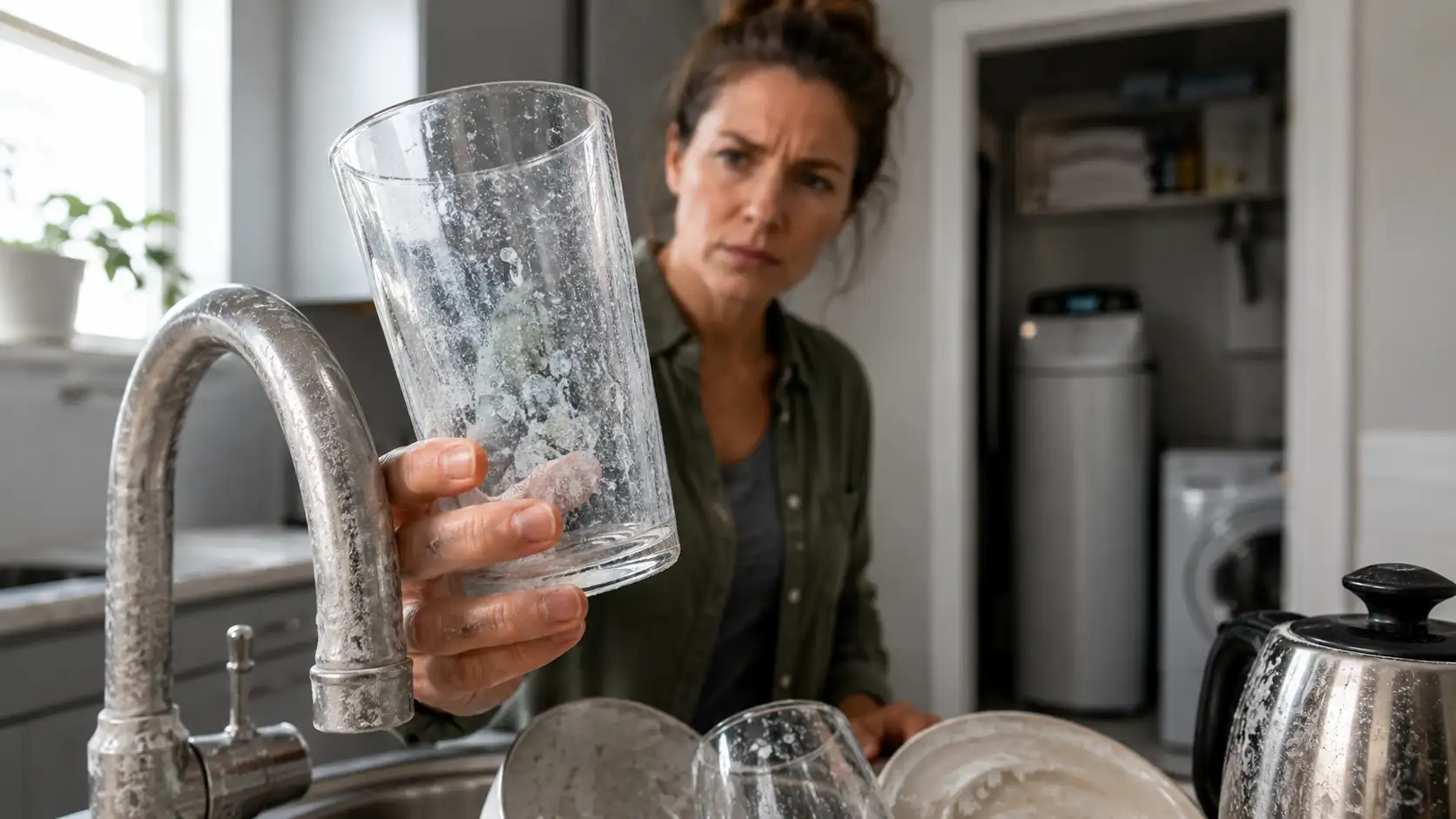
White spots or a cloudy film on dishes are common signs that hard water minerals are passing through the softening system. The spots are usually mineral deposits left behind after water evaporates.
A small amount of spotting may occasionally be caused by dishwasher settings or detergent problems. However, if the problem appears suddenly and affects dishes throughout the home, the water softener should be inspected.
You may notice deposits on:
- Drinking glasses and cutlery
- Stainless steel sinks and faucets
- Shower doors and bathroom mirrors
- Coffee makers and kettles
- Pots, pans, and dishwasher interiors
These deposits are not usually dangerous, but they can be extremely persistent. They also provide an early warning that similar mineral buildup may be developing inside pipes and appliances where it is much harder to see.
Your Skin Feels Dry or Irritated
Softened water often feels smoother because soap rinses away more effectively. When hard water returns, your skin may begin to feel dry, tight, itchy, or coated after bathing.
Hardness minerals can leave residue on the skin and may interfere with soaps and body washes. Some people also notice that they need more moisturizer than usual or experience increased irritation after showering.
Of course, dry skin can have many causes, especially during a long Canadian winter when indoor heating seems determined to remove every molecule of moisture from the air. However, if dry skin appears together with water spots, reduced soap lather, and mineral deposits, your water softener may be the common denominator.
Your Hair Feels Dull or Difficult to Manage
Hard water can leave mineral residue on the hair, making it feel rough, heavy, dry, or difficult to style. Shampoo may not rinse out completely, and conditioners may seem less effective.
Colour-treated hair can also lose its brightness more quickly when exposed to hard water. In some cases, mineral buildup can make light-coloured hair appear slightly dull or brassy.
If your hair care routine has not changed but your hair suddenly behaves as though it has developed a personal grudge against you, test the water before replacing every product in the bathroom.
Scale Is Building Up Around Faucets
Visible scale is one of the clearest signs that your home is receiving hard water.
Scale usually appears as a white, grey, or slightly yellow crust around faucets, showerheads, drains, and other fixtures. It may begin as a thin film but gradually become harder and thicker.
Common places to check include:
- Faucet aerators
- Showerhead openings
- Toilet bowls and tanks
- Humidifiers
- Kettles and coffee machines
- Washing machine connections
- Hot water tanks
Removing surface scale may improve the appearance of a fixture, but it does not solve the source of the problem. If the water softener is malfunctioning, deposits will continue returning.
Professional testing can determine whether the issue is caused by the softener, incorrect system settings, exhausted resin, a blocked component, or another water quality problem.
Laundry Feels Stiff or Looks Dull
A working water softener helps laundry detergent dissolve and rinse more effectively. When hard water enters the washing machine, clothing and towels may begin to feel rough or stiff.
White fabrics can appear grey, while coloured clothing may lose brightness. You might also notice detergent residue or a slightly unpleasant smell even after a complete wash cycle.
Adding extra detergent is not always the answer. In fact, using too much detergent can create additional buildup inside the machine and on clothing.
If your towels have gone from soft and fluffy to something closer to light-duty sandpaper, your water softener deserves attention.
Water Pressure Has Decreased
A noticeable drop in water pressure can sometimes indicate a problem inside the water softener.
Mineral deposits, resin beads, sediment, or a blocked control valve may restrict water flow through the system. In other situations, the softener may not be responsible at all, and the restriction may be located elsewhere in the plumbing.
Low water pressure should be investigated carefully because several components may be involved. Attempting to disassemble a softener without understanding its internal parts can make the situation worse or release resin beads into the plumbing system.
A trained technician can determine whether the pressure loss is connected to the softener or another part of the home’s water system.
The Salt Level Never Changes
A water softener uses salt to regenerate its resin bed. During regeneration, the system flushes accumulated hardness minerals away and prepares the resin to soften water again.
If the salt level remains exactly the same for several weeks, the system may not be regenerating properly.
Possible causes include a malfunctioning control valve, incorrect timer settings, a clogged injector, a disconnected motor, or a salt bridge. A salt bridge occurs when a hard crust forms above the bottom of the brine tank. The tank may look full, but the salt beneath the crust is not dissolving correctly.
Breaking a small salt bridge may seem simple, but repeated bridging often points to moisture, salt quality, or system-setting issues that should be properly diagnosed.
The System Uses Too Much Salt
Using no salt is a problem, but using an unusually large amount of salt can also indicate trouble.
Excessive salt consumption may be caused by incorrect hardness settings, frequent regeneration cycles, a leaking valve, or a system that is too small for the household’s water usage.
Household changes can also affect salt use. More residents, additional laundry, frequent guests, or a new appliance may increase water demand. However, a sudden increase without an obvious explanation should be investigated.
A professional can review water hardness, household consumption, system capacity, and regeneration settings to identify the cause.
The Water Tastes Different
A water softener is primarily designed to reduce calcium and magnesium. It is not intended to remove every taste, odour, chemical, or contaminant.
Still, a noticeable change in taste may signal that the system is not operating as expected. The water may taste more mineral-heavy, slightly metallic, salty, or simply different from normal.
Salty water can indicate a problem during the regeneration cycle, such as improper rinsing or a control valve malfunction. A mineral taste may suggest that hard water is bypassing the softener.
Because taste changes can also come from plumbing, municipal water changes, wells, filters, or hot water tanks, proper testing is more reliable than guessing.
The Water Softener Runs Constantly
Regeneration usually occurs at a programmed time, often during the night when household water use is low. The process should not continue indefinitely.
If you hear the system running for hours, regenerating repeatedly, or cycling at unusual times, there may be a problem with the control head, timer, sensor, valve, or programming.
Continuous cycling wastes water and salt and can place unnecessary strain on the equipment.
Turning random dials and pressing buttons until the noise stops may feel productive, but it can erase important settings or create a second problem. A professional diagnosis is usually faster and safer.
Your Water Hardness Test Shows High Readings
The most reliable way to confirm that a water softener is working is to test the water.
A simple hardness test can compare untreated water with softened water. If the softened water still contains significant hardness minerals, the system may be bypassed, incorrectly programmed, depleted, damaged, or overdue for maintenance.
Testing is especially useful because many water softener symptoms overlap with other household issues. Cloudy dishes may involve a dishwasher. Dry skin may be related to the weather. Low pressure may come from plumbing.
A hardness test replaces guesswork with actual numbers.
Companies providing professional water treatment services in Calgary can evaluate both the equipment and the water itself, helping homeowners determine whether the softener requires maintenance, repair, adjustment, or replacement.
Why Water Softeners Stop Working
Water softeners contain several components that must work together. A failure in one area can affect the entire system.
Common causes include salt bridges, blocked injectors, worn seals, resin deterioration, motor problems, incorrect settings, damaged valves, power interruptions, sediment buildup, and improper installation.
The age of the system also matters. Resin can gradually lose its ability to capture hardness minerals, particularly when exposed to chlorine, iron, or heavy sediment. Older control valves may become less reliable, and replacement parts may be difficult to obtain.
Regular professional maintenance can identify worn components before they cause a complete system failure.
Repair or Replace the Water Softener?
Not every malfunction means that the entire water softener must be replaced.
A relatively new system may only need cleaning, reprogramming, a new seal, or a control valve repair. An older system with damaged resin, recurring leaks, inefficient salt use, and outdated controls may be more economical to replace.
The decision should consider the age of the equipment, repair cost, water quality, household size, salt efficiency, water consumption, and availability of replacement parts.
A professional water treatment specialist can test the system and explain the available options without relying on guesswork.
Do Not Ignore the Warning Signs
A malfunctioning water softener may seem like a minor inconvenience at first. However, hard water can gradually create scale inside pipes, water heaters, dishwashers, washing machines, humidifiers, and other appliances.
The earlier the problem is identified, the easier it may be to correct.
Watch for changes in soap performance, mineral deposits, laundry texture, skin comfort, water taste, pressure, and salt consumption. When several symptoms appear together, the system should be professionally inspected.
Your water softener may not be able to speak, but it has plenty of ways to complain. The key is noticing the signs before your faucets, towels, dishes, and water heater join the protest.